

First Baroque Violin lessons - Part 3

We have already spoken a great deal about the bow—the soul of the violin. But at some point, it is time to turn our attention more closely to a lifelong pursuit of all musicians: intonation.
Intonation
One might think that intonation is simple—either it is in tune or it is not! Of course, that is true, but we must remember that today we are accustomed to the equal temperament of the piano. Equal temperament divides the octave into twelve equal semitones of 100 cents each—yet in doing so, the specific character of each key is largely lost.
In the Baroque period, however, this system was unknown. Instead, there were various approaches to tuning keyboard instruments in order to preserve the unique character of each key in different contexts. J. S. Bach engaged deeply with this question and ultimately presented his solution in The Well-Tempered Clavier (BWV 846–893). The term “well-tempered” may refer to a system developed by Andreas Werckmeister in 1681, in which the problematic “wolf fifth” of meantone tuning was tempered—at the expense of perfectly pure thirds—making it possible to play in all keys.
This blog, however, is not about historical tuning systems—there are many excellent explanations available online (for example, the Cappella Academy series).
Instead, I would like to continue our Baroque violin lesson in a practical way and help you produce a better tone on the violin.
Intonation and sound
Intonation has a profound effect on our tone. Especially on the Baroque violin, it is both important and rewarding to play in tune. Since we:
use much less vibrato (vibrato being an ornament, used sparingly but effectively—more on this in another blog),
play on gut strings, which are richer in overtones than metal strings,
aim to create as much resonance as possible from the instrument,
and seek to create resonance within the ensemble,
it is truly worthwhile to become aware of difference tones. When an interval is perfectly in tune, one hears a gentle “buzz” or an additional third tone.
A common issue today
Here we encounter another important difference between many modern approaches to intonation and those of the finest Baroque musicians.
In many of my students, I observe—very generally—that sharps tend to be played too high and flats too low. This may be due to several reasons:
They are used to playing with the piano in equal temperament.
They think more melodically than harmonically—leading tones are pushed upwards to make melodies sound more brilliant.
They are accustomed to almost continuous vibrato, which not only distracts from the bow but also makes precise listening to intonation much more difficult.
How can we develop pure intonation?
The overtone series
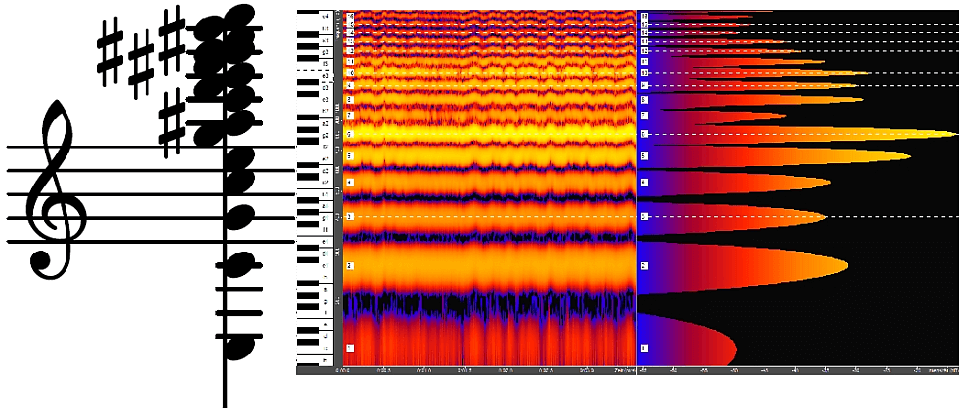
First, we experiment with the overtone series on the violin. This is a fascinating and rewarding exercise, as it connects theoretical understanding with practical experience. We also discover that producing overtones requires proper bow technique.
(Thankyou to Peter Michielson)
Difference tones
Next, we explore intervals and learn to recognise the corresponding difference tones. This requires training the ear, and at first it helps to know what to listen for.
In his violin treatise Versuch einer gründlichen Violinschule (1756), Leopold Mozart gives the following guidance:
Play a minor third, and you will hear an additional tone—a major third (or tenth) below the lower note.
Play a major third, and you will hear an additional tone an octave below the lower note.
Play a perfect fourth, and you will hear an additional tone a fifth below the lower note.
Play a minor sixth, and you will hear an additional tone—a major third (or tenth) below the lower note.
Play a major sixth, and you will hear an additional tone a fifth below the lower note.
A musical companion
After a few weeks—practising just 15 minutes a day—you begin to develop the ability to hear these tones. Not only is this enjoyable, but you gain a constant companion: this third tone is always present, guiding you in every musical task.
It gives both confidence and a deeper, warmer sound.
And when we begin to hear it in ensemble playing—just imagine how beautiful that can be!
Enjoy your practice, and see you next time! 🎻l!


Comments